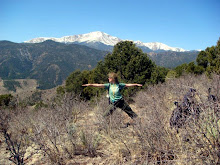
I mentioned in my last post that I'd had a visceral negative reaction to Sedona -- undeniably one of the most beautiful places on earth -- which surprised and dismayed me. I had a vague sense that I was offended by the opulence and pseudo-spiritualism of the place, but that didn't completely explain my snarky attitude which, I've come to understand, usually masks a deeper response to perceived injustice or dashed hopes.
I found an answer in the form of a book I happened to pull from my brother's bookshelf: An American Child Supreme -- the education of a liberation ecologist, by John Nichols. It's a memoir of sorts, and tries to decipher how any of us -- born into a culture that very nearly ensures that we become bigots, greedy consumers, warmongers, and environmental parasites -- develops a social conscience.
John Nichols tells of the life-changing -- often seemingly innocuous -- events, people and books that transformed him from a product of a privileged upbringing and Mayflower pedigree to a liberation ecologist (as opposed to naturalist or environmentalist), a more radical superstratum of social ecology.
I won't go into any of that, although it was fascinating to me. I'll just write the words that I scratched frantically into my little notebook so I'd not lose them or allow myself to forget them. I wasn't sure how they related to Sedona, but somehow they did.
Myself, I do not have the courage or the fanaticism that motivated Diana Oughton (of the Weather Underground) to build bombs, but I cannot envision the changes we need without some sort of apocalyptic reaction against the current levels of violence generated by the daily economic activities of the multinationals that feed and clothe us.
Territorial shooting wars are only a small fraction of the greater (and more horrific) violence of a world market that levels forests, pollutes the oceans, impoverishes people and toxifies topsoil in order to bring us our hamburgers, polyester golf slacks, and Marlboro cigarettes. "The human murder by poverty in Latin America is secret," writes Eduard Galeano. "Every year, without making a sound, three Hiroshima bombs explode over communities that have become accustomed to suffering with clenched teeth. This systemic violence is not apparent but is real and constantly increasing: its holocausts are not made known in the sensational press but in Food and Agricultural Organization statistics."
Environmental collapse is now universally caused by monopoly capital plundering earth's biological and human resources for profit. The profit is generated by the labor of those underdogs, whose energy is thus co-opted to destroy the environment. This means that our most destructive environmental problems are tied to their inequality. . . . That inequality is causing a downward social spiral on earth and eco-devastation. Profit requires demolition. The racism that deforms our nation (and the globe) is a tool used by a capitalist society to maintain class divisions for profit-making reasons, so racism is also a main component of biosystem toxicity.
John Nichols sums up the philosophy of a liberation ecologist when he quotes Tom Athanasiou's book Divided Planet: The Ecology of Rich and Poor, whose words are directed at environmentalists:
"The time for such political innocence is over. . . .it is past time for environmentalists to face their own history, in which they have too often stood not for justice and freedom, or even for realism, but merely for the comforts and aesthetics of affluent nature lovers. They have no choice. History will judge greens by whether they stand with the world's poor."
That must be it. I distrusted Sedona because it quite obviously doesn't stand with the world's poor, nor even the nation's middle class. It is an enclave for affluent nature lovers whose social consciences are buried in crystals and energy forces, $4 iced teas and expensive gauzy skirts.
Sedona seems to care not a whit about social or economic justice nor -- I'd wager a guess -- about wreaking environmental havoc in Utah and New Mexico to keep its own little slice of Eden energized and enflowered. There is no need for Sedona to worry about the larger world, neither liberation for its people nor the sustainability of its global environment. Sedona exists unto itself and its wealthy denizens -- to be owned, developed and distributed and enjoyed at their directive.
Saturday, May 9, 2009
Phony Sedon-y


Friday, May 8, 2009
Ya'at'eeh from Tuba City

I'd envisioned myself hiking alone in Sedona for three magical days, vortexed into a frenzied energy, taken by wizened hippies to a hillside lair for impromptu meditation. Instead, in spite of the brazenly gorgeous Sedona landscape, I felt the whole place to be a pseudo-spiritual, wildly affluent, corporate-run and supremely phony tourist trap. I was dismayed to feel this way about such a beautiful place, and tried to lecture myself into giving further consideration, but to no avail. I got the hell out of Nirvana Dodge after a single (albeit lovely) hike.
That was yesterday. Today I headed north out of Flagstaff on Highway 89 with no particular plan. Shortly after the city faded from the rearview and I was facing the open road, I turned on the radio and heard "You're listening to Indian Public Radio." This heralded a perfect Tony Hillerman-esque adventure, I was sure of it, and I was flooded with good cheer.
From the radio came gentle Indian flute sounds, haunting-dancing-with-wolves-vision-quest sounds, which had the hair on my arms standing instantly at attention. Within thirty seconds, however, a techno track and a Navajo-accented rapper barged into the song, resulting in a somewhat bizarre Eminem/Kokopelli kind of thing. I was enthralled.
A retrospective about Harold Drake's radio show "The Church in Your Hogan" was next, followed by a short discussion of cultural taboos associated with Indian suicide, and an admonition to speak openly about such things. Fleetwood Mac, Peter Frampton, and then this song by some sweet-voiced Hopi girls:
Hey, Cousin! Nice to see you again!
Do you have any duck tape, Cousin? Because my muffler fell off again.
Duck tape. Sigh. Indian glue.
I was becoming giddy.
I took the Navajo Trail (Highway 160) east onto the Navajo reservation and soon came upon Tuba City, a dusty little town of 8,000 residents and seemingly little else. I drove down Main Street and saw house after house boarded up and nothing but dry dusty fields all around. I don't know where the actual people live, but the town seems reserved for ghosts. In front of the elementary school, at two in the afternoon, were twenty long yellow school buses awaiting what couldn't possibly be that many kids. In fact I didn't see any kids, yet one after another the buses pulled slowly away from the curb. Maybe each rural denizen has his or her own bus.
I went into the trading post/interactive Navajo museum ($9)/internet café hoping to find authentic Indian crafts. The store had some very nice moccasins which, on closer inspection, were made by Minnetonka Moccasins -- a big corporation headquartered in Minnesota. I tried on a cute black straw cowboy hat made by some beachwear company in Oregon. Then I spied a truly adorable backpack purse of Indian-patterned wool and leather, manufactured -- big sigh -- by Pendleton, the company responsible for the boiled wool jackets of my Junior League days.
I couldn't find anything else to do in Tuba City, so I ate some trail mix in the car, drank some warm water from my CamelBack, and did some research on Tuba City. Here are some fun facts:
1. It is the Navajo Nation's largest community.
2. It was founded by the Mormons in 1872.
3. It was a uranium boom town in the fifties, and regional headquarters for the Atomic Energy Commission.
4. Songwriter-musician Glenn Danzig got his ass kicked in a Tuba City nightclub. It was caught on tape and can be seen on YouTube.
5. SPC Lori Piestewa of Tuba City was the first woman killed in the current war against Iraq. She died in the same ambush that injured her best friend, Jessica Lynch.


Friday, April 3, 2009
Tim DeChristopher talks Edward Abbey

Tim DeChristopher, a University of Utah disobedient civilian, was interviewed on Democracy Now! today. Amy Goodman asked him what relevance Edward Abbey had to his move to disrupt the bidding process for oil and gas leases in Utah's red rock country.
His answer:
I think that the most powerful relevance of Edward Abbey to what I did was his statement and really his expression of the idea that sentiment without action is the ruin of the soul, because I think that’s what I had seen throughout my work as an environmentalist previous to this, where I had seen this massive crisis and massive challenge that we were facing in climate change, and I saw that my efforts of writing the letter here and there and riding my bike and things like that weren’t really aligning. My actions weren’t aligning with my sentiment of how serious this threat was, and I knew that. And so, I felt that kind of conflict within myself.
And when I stepped it up at this auction and was putting myself out there and winning all these parcels was really the first time I felt like my sentiment—or I felt like my actions were aligning with my sentiment. And I felt this tremendous sense of calm when I started doing that, because for the first time that conflict within me was gone, and I knew that when I was, you know, standing up and risking going to prison, my actions really were aligning with how big of a crisis this is.
A grand jury indicted Tim DeChristopher Wednesday afternoon with two felony counts of violating the Federal Onshore Oil and Gas Leasing Act. If convicted, Tim could face up to 10 years in the slammer. This, despite the fact that Ken Salazar cancelled the contested leases because the government failed to follow its own procedures, but more on that later!
For now, tune in to KRCC at 7 to hear Tim (and then Noam Chomsky) on Democracy Now! tonight.
Wednesday, January 14, 2009
Revolutionaries in the wilderness

Edward Abbey presaged America’s current path to tyranny forty years ago and predicted that the end of American democracy would be coincident with the destruction of the wilderness.
What’s the connection between democracy and wilderness? Personal liberty is a fleeting commodity, according to Abbey, and history has shown that governments invariably move toward totalitarianism. When faced with authoritarian governance, wilderness is crucial because it serves as both a refuge from political oppression and a base for guerrilla warfare. Uprisings in urban settings are too quickly quelled by those with better weaponry, but hidden in mountain, desert or jungle settings, revolutionaries can gain an edge on establishment forces and engage in protracted — sometimes successful — battle. Consider Che in the mountains, the Vietcong in the jungle, Osama bin Laden in a desert cave.
From Desert Solitaire:
Suppose we were planning to impose a dictatorial regime upon the American people — the following preparations would be essential:
1. Concentrate the populace in megalopolitan masses so they can be kept under close surveillance and where, in the case of trouble, they can be bombed, burned, gassed or machine-gunned with a minimum of expense and waste.
2. Mechanize agriculture to the highest degree of refinement, thus forcing most of the scattered farm and ranching population into the cities. Such a policy is desirable because farmers, woodsmen, cowboys, Indians, fishermen and other relatively self-sufficient types are difficult to manage unless displaced from their natural environment.
3. Restrict the possession of firearms to the police and the regular military organizations.
4. Encourage or at least fail to discourage population growth. Large masses of people are more easily manipulated and dominated than scattered individuals.
5. Continue military conscription. Nothing excels military training for creating in young men an attitude of prompt, cheeful obedience to officially constituted authority.
6. Divert attention from deep conflicts within the society by engaging in foreign wars; make support of these wars a test of loyalty, thereby exposing and isolating potential opposition to the new order.
7. Overlay the nation with a finely reticulated network of communications, airlines and interstate autobahns.
8. Raze the wilderness. Dam the rivers, flood the canyons, drain the swamps, log the forests, strip-mine the hills, bulldoze the mountains, irrigate the deserts and improve the national parks into national parking lots.
In a final round of environmental fuck-yous, the Bush administration has offered up significant portions of pristine Utah wilderness to oil exploration. Aside from one notable monkeywrenching incident, the trashing of the American wilderness continues unabated.
Wednesday, September 10, 2008
Cheyenne Mountain State Park awaits

Here are a few possible reasons people are staying away:
1. No dogs on the trails
All I can say is YHGTBFKM. What pencil-pushing couch potato came up with this idea? This is Colorado Springs, Dog Fancy's choice as the most dog-friendly city in the country. People here love their dogs. People here not only walk their dogs daily, they hike their dogs daily. They love big athletic energetic dogs, and those dogs need 1600 acres of open space and 20 miles of hiking trails to be happy.
Park signs explain that the ban protects our precious pooches from predators and rattlesnakes. Well, if this is the case, why aren't they concerned about ME? And shouldn't pet owners be allowed to determine what risks they are willing to assume? Post a sign warning of potential dangers and leave it at that.
2. $6 day pass
I understand that state parks need to generate revenue, but couldn't there be some wiggle room here? An annual park pass is $60, which isn't
crazy expensive, but, still, there is something sort of offensive about having to cough up money to visit a park that's in our back yard. Especially when we have so many free trails nearby. Couldn't the park provide locals a discounted pass, or offer free entrance for walk-in traffic? In any case, they need to do something to make local day trippers feel welcome.
3. Campsites and most picnic areas are NOT OPEN yet
Despite the fact that the park opened in 2006, the park isn't very open. How is CMSP expecting to lure out-of-town visitors -- visitors with campers and tents and zillions of other outdoorsy choices -- when the park is basically unusable?
A park ranger told me that they hoped to open the park to campers at the end of September. He also said that they might have to scale back certain phases of the park's development plan because of budgetary concerns. Let me get this straight. CMSP missed the whole summer season, their entire annual revenue season, to focus on construction, and now they have to cut back construction because they have no money? The word mismanagement is on the tip of my tongue.
4. Zero community outreach
How many of you know anything about Cheyenne Mountain State Park? Do you know how to get there? Do you have a map of the trails? Do you
know that their visitors center is set up to host parties and wedding receptions? Do you know about the prairie-to-peak ecosystems unique to CMSP? I'm guessing you don't.
Yes, the park is short on funds and can't do big slick marketing campaigns. But until CMSP is open to the Airstream set, shouldn't they be targeting us locals? They could get the word out to thousands of Colorado Springs residents by having an inexpensive booth at Springspree, Pridefest, or the Diversity Fair. They could host an annual picnic at the park to draw in the community. They could set up tables outside high-traffic retailers, like the Girl Scouts do, and hawk shirts and hats, hand out information, and sell annual park passes. There is no shortage of open-space do-gooders willing to do the legwork.
Okay, bitchfest over. Now the plea. CMSP is a community jewel. A few noble souls fought the good fight against developers aimed at turning the foothills of Cheyenne Mountain into a sea of little boxes. Wide open space is a gift, better than Prozac, more fun than Mr. Biggs. It keeps us grounded. It keeps me sane. If budgetary pressures mount, we will see the state parceling off the park for sale. We'll see a cutback in hours, services and personnel, which will only make things more precarious.
So go! Go to the park. Skip the fast food lunch and pay the $6. Better yet, cough up $60 for an annual pass and go any time you please. When it opens for camping in a few weeks, do an overnight just for fun. It's a great way to enjoy camping without the usual hassles. Grill some steaks. Make s'mores. You can even bring Fido if you keep him off the trails.
This park needs local support to survive. It's a work-in-progress. Express yourself to the powers-that-be. Tell them what you like, and what you'd like to see changed. I think they'll listen. They want us there. So let's be there. 


Friday, July 18, 2008
Mellow yellow
 When I visited Southern California in the mid-eighties, I was bedazzled by my boyfriend's beachside neighborhood. Tiny stucco houses. Flowering vines crawling weatherworn trellises. Impossibly narrow streets. Sandy restaurants serving fish tacos. Cramped outdoor patios overlooking the ocean -- the vast inconceivable Pacific ocean. An exciting vista for a Colorado girl.
As with all lovers' trysts, the visceral has faded to ephemera, and I am left with only a sense of place and time. However, one tangible relic remains from my visit, and it was recently brought to mind afresh. If it's yellow let it mellow; if it's brown flush it down. In case you've not heard this California incantation, it is a reference to pee and poo, number 1 and number 2, realities that, to my mind, are best left behind stall doors. In any case, they should not be fodder for a state mantra. Drought be damned!
After many years of recklessly rejecting the admonition, I am prepared to pass California wisdom on to my Colorado offspring. Why? The Gazette reported this week that 1/3 of a typical household's water usage goes to flushing the toilet. A third! I have six Kool-aid swilling children so the flushing in our house, reinforced rigidly by prissy mother me, is nonstop.
No more. New rule. If it's yellow let it mellow; if it's brown flush it down. I have yet to divine an apt consequence for willful disobedience.
-----
Wednesday, May 21, 2008
Fat cows
 I’ve read quite a bit about vegetarianism over the years. Nutritionists assert that in order to be healthy a vegetarian must actively seek the full complement of amino acids that make up protein, the building blocks of our bodies, by consuming protein. This sounds like a reasonable assertion, but does it hold true in nature? Do living organisms, all of which are basically organized proteins, require ingested protein to survive?
Think of cows. What do they eat as they grow fat and delicious, merrily trotting the path to becoming culinary delights for the non-vegetarian population? Do they eat thick steaks, succulent chickens, light flaky fish, or the other white meat, pork? No, of course they don’t. They eat only plants — grass and hay — and only as much as they need.
Recent research suggests that our grains, fruits and veggies have become less nutritious over the past century. Man’s interference with the growth of plants — breeding for certain marketable traits, using chemical pesticides, artificially propping up the depleted soil with chemical fertilizers, speeding the ripening process — has resulted in not only dangerous food, but less nutritious food.
Animals are instinctive. They know what they need. They neither over- nor under indulge. I mean, have you ever seen an overstuffed cow, lying on her side in a meadow, moaning oh my god, I feel like a fat cow? No, nature provides every needed nutrient, in proper portions and proportions, for our cattle.
Or at least she used to. These days, ranchers do, in fact, encounter fat cows, dissatisfied cows, cows with big hay bellies. When cows aren’t getting needed nutrients from the grass they eat, they eat more, and more again, until they do. The fact that ranchers are seeing hay bellies is an indication that food ain’t what it used to be. We have a similar problem. As Big Food alters the natural food supply to ensure that food looks pretty, has a long shelf life, is conveniently packaged, transported, and prepared, we are starving to death. Without micronutrients like resveratrol to signal satiety, without phytochemicals, enzymes, vitamins and minerals to nourish and support our biochemical processes, we’re eating more and more to gain needed nutrients, and we’re getting fatter and unhealthier in the process.
Tags: Big Food, Environment, Nutrition
Friday, May 16, 2008
Wisdom from my favorite author

Something will have gone out of us as a people if we ever let the remaining wilderness be destroyed; if we permit the last virgin forests to be turned into comic books and plastic cigarette cases; if we drive the few remaining members of the wild species into zoos or to extinction; if we pollute the last clean air and dirty the last clean streams and push our paved roads through the last of the silence, so that never again will Americans be free in their country from the noise, the exhausts, the stinks of human and automotive waste. And so that never again can we have the chance to see ourselves single, separate, vertical and individual in the world, part of the environment of trees and rocks and soil, brother to the animals, part of the natural world and competent to belong in it. Without any remaining wilderness we are committed wholly, without chance for even momentary reflection and rest, to a headlong drive into our technological termite-life, the Brave New World of a completely man-controlled environment. We need wilderness preserved-- as much of it as is still left, and as many kinds-- because it was the challenge against which our character as a people was formed. The reminder and the reassurance that it is still there is good for our spiritual health even if we never once in ten years set foot in it. It is good for us when we are young, because of the incomparable sanity it can bring briefly, as vacation and rest, into our insane lives. It is important to us when we are old simple because it is there–important, that is, simply as idea.
Wallace Stegner, The Wilderness Letter, 1960
-----
Friday, May 9, 2008
Tiny prophets
 If we listen closely, there's a small voice in the wilderness, calling out to us, warning of a coming transformation.
No, it's not John the Baptist. It's America's honey bee, dying by the millions, prophesying the demise of the country's fruit and vegetable supplies. More than a hundred crops rely on bee pollination for survival, yet bees are dying off by the millions -- 90% of the feral bee population has died -- due to a mysterious condition called Colony Collapse Disorder. No doubt it is due to man's interference with delicate natural goings-on, and his extreme disrespect for the Earth herself. The health of the planet is being sacrificed on the the altar of corporate ignorance and greed.
A really amazing documentary called Vanishing of the Bees is in the works. Check out the trailer here. Seriously, check it out.
If this war and those to follow, global warming, environmental toxins, inaccessible health care, the credit collapse, the burning of the Constitution, the destruction of community, apocalyptic Christian Zionism, the lies and deceptions and ugliness and hate and greed of this current administration, and the next, aren't enough to cause self-examination and a commitment to change, this may very well be the thing that gets our attention.
Albert Einstein said if honey bees become extinct, human society will follow in four years.
Pre-e-e-pare ye the way of desolation and death. . . .
---
Saturday, April 26, 2008
A woodpecker in El Chaltén

Wednesday, April 16, 2008
Trekking in El Chaltén
Veni, vidi, vici!
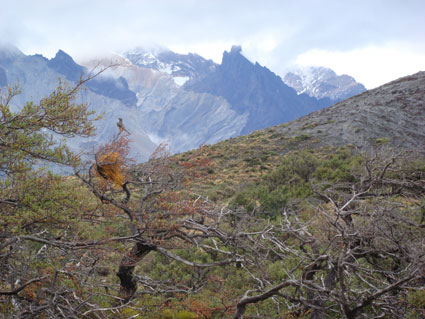
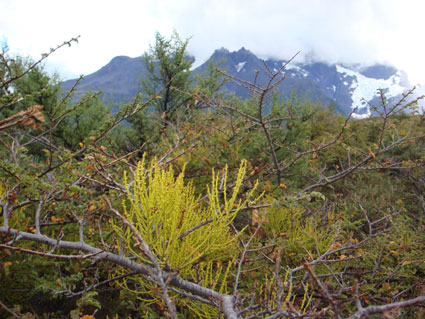
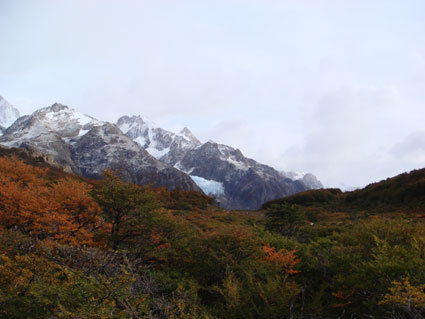
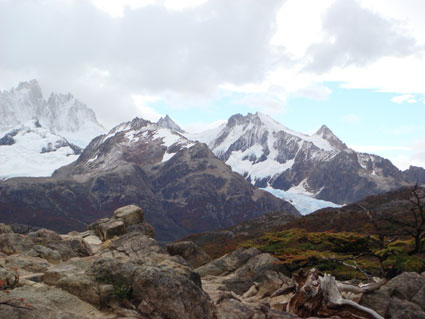
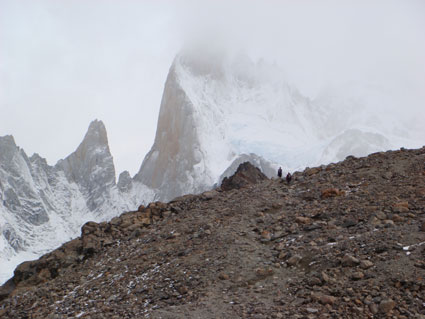
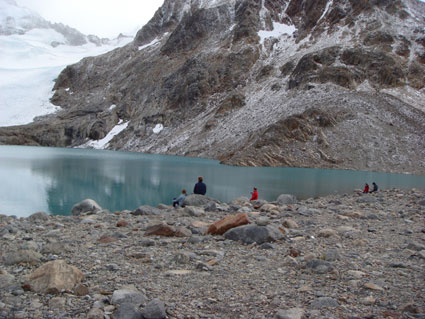
This hike to Lago de los tres in El Chaltén was my very favorite day in Argentina. It took about 9 hours round trip with stunning scenery the entire way, including bunches of glaciers. Mount Fitz Roy, named after the captain of Darwin's Beagle, is in the background.
There was a guy with a little propane stove handing out hot coffee at the top, which was great because it was freezing. Of course, pictures don't do any of it justice!
Autumn in the Andes. Amazing, amazing, amazing!


Wednesday, February 27, 2008
Shedding light on Wal-Mart's mission
 I had the pleasure of seeing Ray Bracy, Senior VP of Wal-Mart, speak last night at CC. I hardly know where to begin, so convinced am I that Wal-Mart truly is making people’s lives better by saving them money.
I’ll focus on Wal-Mart’s contribution to the eco-sustainability movement. Recently, the company vowed to make the new high-efficiency fluorescent light bulbs available to their customer base at an affordable price (they are usually about six times the cost of incandescent bulbs). They succeeded wildly in their endeavor, selling 150 million of them in the past year. In case you don’t know much about these amazing new light bulbs — so fantastic that the Bush administration, at Wal-Mart’s urging I’m sure, have enacted a law making the manufacture or sale of incandescent bulbs illegal in the near future — here are just a few of the wonders of compact fluorescent lightbulbs (CFLs):
* CFLs create an unpleasant and unnatural bluish glare. Deal with it!
* CFLs may cause interference to radios, televisions, wireless telephones/computers, and remote controls; avoid placing this product near these devices. Piece of cake!
* CFLs don’t work well (or sometimes at all) in very cold weather, so operation of porch lights and outdoor security lights in northern states may be erratic in wintertime. Big whoop!
* If a CFL is turned on and off frequently, its energy efficiency drops and its highly-touted life expectancy decreases. Re-train your children to leave the lights on!
* Most CFLs can’t be used with dimmer switches or timers. Who needs romance?
* CFLs won’t fit in many existing lighting fixtures. Back to Wal-Mart!
* CFLs may smoke or smolder, but they probably won’t catch fire. Phew!
If you do encounter a smoldering bulb, don’t worry. Simply follow Energy Star’s (a government program encouraging energy conservation) recommendations:
“If you have a product that does begin to smoke or smolder, immediately shut off the power to the CFL and, once it has cooled, remove it from the light socket. Then, send us e-mail…to alert us of this incident. Please include the product manufacturer’s name and model information that is included on the CFL base and if possible an electronic photo. Also please tell us how the CFL was used – open or enclosed light fixture; indoors or outdoors; base orientation – up, down or sideways. Then visit the manufacturer’s web site to find customer service contact information to inform them of the early failure.” Easy ’nuff!
*CFLs contain mercury, which is poisonous. If the unthinkable happens and the fragile tube breaks, worry not. Just follow the EPAs recommendations for clean up:
To avoid inhaling mercury vapors if a bulb does break, the EPA advises opening a window as soon as possible and leaving the room for at least 15 minutes before starting to clean. Once you start:
• Never allow children or pregnant women near the spill area.
• Always wear rubber gloves; you should never touch mercury with your bare hands.
• Remove all metal jewelry, which might attract mercury magnetically.
• If the bulb breaks on hard flooring, use a piece of stiff paper to scoop up the broken glass and powder. Avoid using a broom that could stir up dust.
• Damp mop hard surfaces to pick up any remaining dust.
• If the bulb breaks on carpeting, use sticky tape to pick up the powder, dust and smaller pieces of glass. Vacuuming could disturb the dust and pose an inhalation risk.
• Afterwards, shine a flashlight to double check the area for missed spots.
• Seal all the rags, paper and tape, as well as the light bulb remains, in a plastic bag. Double bag it, and dispose at a household hazardous waste site. See www.earth911.org for one in your neighborhood.
• Wash your hands well and leave the room.
• Leave the window open and turn on a fan to air out the room for at least 24 to 48 hours.
• If you’ve touched mercury or are concerned about your exposure, call the Poison Control Center at 800-222-1222.
Oh, and if you’ve spilled the mercury on a rug, roll it up and place it on the front lawn. Call the EPA and they will come pick it up. Thank you, thank you, EPA!
And heartfelt thanks to Ray Bracy and Wal-Mart for making our lives, and the environment, better by saving us money!
Sunday, February 17, 2008
Consumers to the very end

If you've ever watched Six Feet Under, you have a sense of what happens to the body prior to a conventional funeral and burial. If this is an indignity that you are willing to suffer, and a price tag that you are willing to bear, so be it.
But consider for a moment the environmental impact of the typical funerary send-off.
After the funeral service, the body is sealed inside a metal casket or lacquered wooden coffin lined with plush satin and adorned with gleaming brass accessories. This is then lowered into a concrete vault and buried. The reinforced concrete tomb is covered with a ton of dirt, and planted with non-native grass which is kept artificially green with pesticide and weed killer.
A ten-acre tract of cemetery ground hides enough coffin wood to construct more than 40 homes, and contains nearly a thousand tons of casket steel and another twenty thousand tons of concrete.
Formaldehyde, the primary ingredient in embalming fluids and a known carcinogen, is another concern. Nearly a million gallons of embalming fluid are buried every year in North America, some of which eventually leaches out and runs into surrounding soil and groundwater.
Above ground, the local cemetery looks peaceful and pastoral. But below the surface it serves, to all intents and purposes, as a landfill of hazardous wastes and non-biodegradable materials. An affront to nature, to be sure. A modern natural burial, wherein the body is returned to the earth to decompose naturally and be recycled into new life, is an environmentally sustainable alternative to existing funeral practices. The body is prepared for burial without chemical preservatives and is buried in a simple shroud or biodegradable casket that might be made from locally harvested wood, wicker or even recycled paper.
A completed natural burial preserve is a green place with trees, grasses, and wildflowers, which in turn bring birds and other wildlife to the area. It is a living memorial and leaves a legacy of care for those of us who respect the earth and understand our connection to it.
What could be more organic than to become a part of nature? Death does, after all, complete the circle of life. I find it comforting to know that my body will someday enrich the soil and allow living things to flourish. Maybe a molecule of mine will end up in a berry eaten by a bird. More likely, I'll be in a nut eaten by a manic squirrel.
------
Tuesday, February 12, 2008
Lighting the fire within
 Certain words are tossed around in casual conversation without ever being clearly defined and, in the process, take on a distorted meaning or are ignored altogether. For me, one is holistic. To my mind, this word has been co-opted by New Age metaphysical sorts and healing arts practitioners. But, in reality, there couldn't be a better word to describe many of the noble causes to which we all subscribe--going green, healthy living, even liberal arts education.
Let me start with a definition. Holism: the theory that living matter or reality is made up of organic or unified wholes that are greater than the simple sum of their parts. Basically our American patchwork approach to problem solving, be it national health, poverty, education, the environment or foreign policy, is destined to fail because we don't address root causes and global realities, nor do we provide holistic solutions.
Most Americans exist completely apart from the natural order. We live in artificial dwellings, are transported by artificial means and "nourished" by artificial foods. We wear high heels, mask all body odors, prepare meals in toxic cookware, wrap our bodies in synthetic materials. We pop pills to feel better and lose ourselves in electronic black holes to assuage boredom. Many of us live lives of isolation, like lone wolves, instead of in community with our fellow human beings.
Some of the more visionary among us provide suggestions for improvement. No more plastic bags! Wear hemp clothing! Eat organic! Bike to work! Use crystals to deodorize! Give free hugs! Such solutions are mere band-aids on a gaping wound. They are unable to stem the flow of blood, but they somehow make us feel better.
My children are learning about the benefits of recycling. Period. I think the conversation should be expanded. Instead of taking our cans to the curb, why not vow never again to drink anything that comes in a can? Or, even better, any beverage besides water. Let's teach our kids that canned and bottled beverages are inherently unhealthy for the body, as well as detrimental to the environment. With a more holistic approach, the need to recycle would become less urgent, and the children would be better educated and healthier.
A holistic solution to energy conservation and national obesity can be found in the home thermostat. Many of us have turned down the heat to conserve energy. Good for the planet, no question. From a more holistic perspective, is it natural for man to live in a tightly climate-controlled environment? It isn’t. But our bodies have adapted to this artificial reality over time and we feel impelled to preserve it. So while we may turn down the thermostat, we bundle ourselves up to maintain the status quo.
I like to keep my house cool, about 60 degrees. I wear t-shirts and drink ice water and my little kids, with barely an ounce of body fat amongst them, play in their underwear, completely inured to the cold.
Remember that human beings are not dependent on the environment to determine body temperature. It is set biologically and will be maintained naturally in nearly all situations. If the outside temperature is hot, we perspire and our metabolism slows down so our bodies don't overheat. This makes us feel sluggish; hence, the lazy summer day and dog days of summer weather characterizations. If the outer temperature is cooler, the body maintains heat by increasing the rate of metabolism to convert fat to energy. We build a fire within. Not only do we get warmer, we get thinner and more energetic to boot! Over time our metabolic rates are reset at a higher level, and we no longer feel the cold. We are warmed by our own energy source, not by a polyester sweatshirt.
Think about what it means to live naturally, like cavemen. Get familiar with the workings of the body. Ponder what the planet was before man imposed his artificial intelligence upon it. Then attempt to conform to that which is natural wherever you can. What is good for the body will be good for the mind and the spirit, and likely the environment as well.
-----